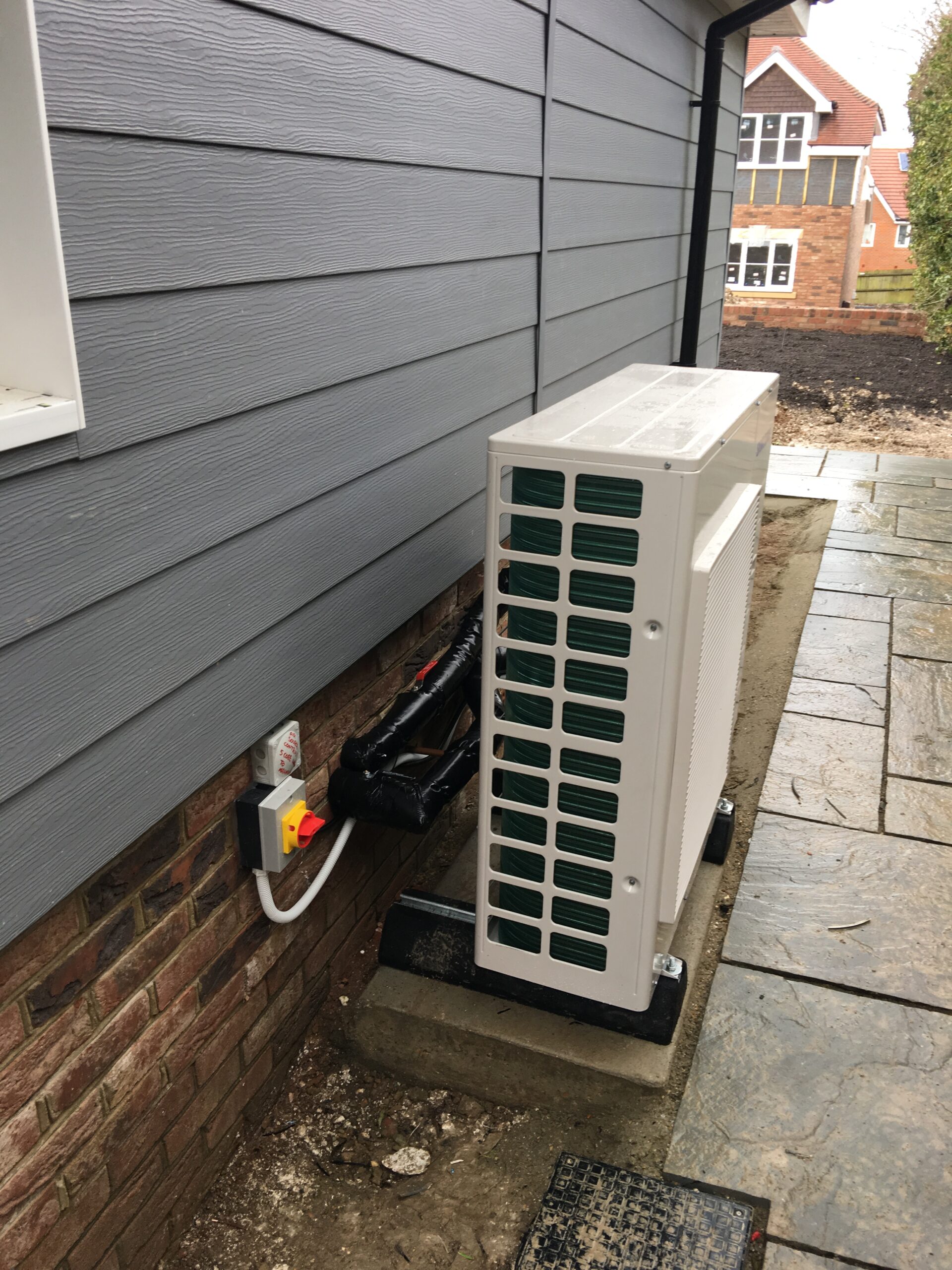
What are Air Source Heat Pumps?
Air Source Heat Pumps (ASHP), also known as Air-to-Water Source Heat Pumps (AWSHP) takes the outside fresh air and transfers this natural heat to the water that passes through the Air Source Heat Pumps.
This natural process of warming the water is the used to help heat and warm your rooms at home using your radiators and underfloor heating solutions just like normal.
Some users of Air Source Heat Pump solutions also use storage tanks to store the heated water in specially designed storage tanks to retain the heat transferred so it can be used for your hot water taps and appliances around your home or property.
Convection is the main method of heat transfer most Air Source Heat Pump solutions use with fluids such as water and air.
The heat from the air being passed through the Air Source Heat Pump is absorbed into the passing fluid, typically water or air, which then goes on to pass through a heat exchanger and into the heat pump which works to raise the fluids overall temperature and then finally transfers this heat to the water.
What are the benefits of using Air Source Heat Pumps?
The benefits Air Source Heat Pumps can provide include lowering your utility bills, more specifically your energy bills, will help to reduce your carbon emissions, all while heating your home and providing hot water.
Are air source heat pumps worth the investment?
The use of Air Source Heat Pumps is most certainly worthwhile as the numerous benefits for using heat pumps to help warm your home and your water supply is unquestionably a great benefit.
Why should I use Air Source Heat Pumps over other options?
There are many factors to support why you should choose Air Source Heat Pumps, and may choose ASHP options, but it’s not for everyone.
- No storage of fuel is required.
- Multiple uses, heating water or rooms.
- Long lifespan.
- Air Source Heat Pumps can heat.
- Low maintenance.
- Easy installation
- Eligible for boiler upgrade scheme. And any other government schemes
- Help save money on energy bills.
- High seasonal Coefficient of Performance (SCOP).
- Low carbon footprint.
The goal of any Air Source Heat Pump solution is to transfer heat absorbed from the outside air to either an indoor heating solution or space.
As mentioned, ASHP solutions are not for everyone as alternative options are more suited to certain applications, for example some of the downsides to Air Source Heat Pumps are:
- They provide a lower heat supply than boilers.
- Air Source Heat Pumps are less efficient below -2°
- Underfloor heating would require additional investment.
- Less savings compared to low-cost mains gas.
- Requires your home to already be well insulated for best efficiency.
So, you may be asking with all of those downsides, why would I still consider Air Source as an option.
Well, Air Source Heat Pumps are highly efficient and a serious contributor to the country’s green energy efforts. With the widespread use of heat pump solutions, the nation would see a significant improvement in bringing low carbon, renewably sourced affordable energy.
What heat pump options are available?
Currently, there are two main forms of Air Source Heat Pump, they are, Air-to-Air Heat Pumps and Air-to-Water Heat Pumps.
Another thing to consider is that in most cases you can’t retain all your existing radiators if you are just looking to replace your boiler or any other fossil fuel heating method with an Air Source Heat Pump solution. So, should you replace your radiators with an Air Source Heat Pump, in most cases, the answer is yes.
Why would I use Air Source Heat Pumps?
You may use air-source heat pumps for several reasons.
Some of the reasons include:
- They can save you money on energy bills by being more efficient than conventional heating systems.
- They can lower your carbon footprint by generating less CO2 than many conventional heating systems.
- They can be used for heating or cooling your property by reversing the process. (not recommended with radiators)
- They are eligible for Boiler Upgrade Scheme which can provide you with financial support.
Air-source heat pumps can reduce your energy bills by using less electricity than conventional heating systems. The amount of money you can save depends on several factors, such as:
- The efficiency of your air source heat pump.
- The type of heating system you are replacing.
- The size and insulation of your home
How long would it take to pay for itself?
The payback period for air source heat pumps depends on several factors, such as:
- The cost of installation.
- The type of fuel you are replacing.
- The eligibility for Boiler Upgrade Scheme (BUS).
A typical payback period for an air source heat pump solution ranges between 2 years to 12 years depending on the payment method you choose, and the choice of heat pump solution.
What are the disadvantages of air source heat pumps?
Some of the disadvantages of air-source heat pumps include:
- They provide a lower heat supply than oil and gas boilers, which may require larger radiators or underfloor heating.
- They are less efficient in cold weather -2, as they must work harder to extract heat from the air.
- They have a high upfront cost for installation, which may not be offset by energy savings or incentives for some homes.
They are bulky, which may affect your home aesthetics and comfort.
Lower heat supply:
Air source heat pumps produce heat at a lower temperature than oil and gas boilers, which means they may not be able to heat your home as quickly or effectively. You may need to install larger radiators or underfloor heating to ensure a comfortable temperature. This can add to the installation cost and space requirements of your system.
Less efficiency in cold weather:
Air source heat pumps work by extracting heat from the outside air, but when the air is very cold -2 and lower, there is less heat available. This means that your heat pump must use more electricity to produce enough heat for your home, which reduces its efficiency and increases your energy bills. You may also need a backup heating system for very cold days.
High upfront cost:
Air source heat pumps are expensive to buy and install compared to other heating systems. The average cost of an air source heat pump installation is between £7,000 and £13,000, depending on the size and type of your system. You may be able to recoup some of this cost through energy savings or government incentives, but this depends on your home’s energy performance and fuel type.
Bulkiness:
Air source heat pumps consist of an outdoor unit that contains a fan and a compressor, which can be quite large. You will need to find a suitable location for this unit outside your home, where it will not affect your neighbours or spoil your view. You will also need to ensure that there is enough space around the unit for airflow and maintenance.
What are the air source heat pump running cost.
The running cost of an air source heat pump depends on several factors, such as:
- The size and type of your heat pump.
- The efficiency and performance of your heat pump.
- The temperature setting and usage pattern of your heating system.
- The electricity tariff and price you pay for your electricity.
- The insulation level and heat demand of your home.
According to some estimates, an air source heat pump costs £1,360 per year to run on average. This is more than it would currently cost to run a gas boiler, but that may change in the future as gas prices rise. You may also be able to reduce your running costs by applying for government grants or incentives.
What are the air source heat pumps costs?
The cost of an air source heat pump depends on several factors, such as:
- The size and type of your heat pump (air-to-water)
- The brand and warranty of your heat pump
- The installation and labour costs
- The complexity and location of your project
According to some estimates, an air source heat pump costs £10,000 on average for supply and installation by an MCS-accredited installer. However, you may be able to get a lower price by applying for government grants or taking advantage of current offers from energy suppliers.
How do Air source heat pumps work?
An air source heat pump works by extracting heat from the outside air and transferring it to your home’s heating system. It uses electricity to power a compressor that increases the temperature of the heat. It can produce up to four times more heat than the electricity it consumes.
The main components of an air source heat pump are:
- An outdoor unit that contains a fan and a refrigerant
- A heat exchanger that transfers heat from the refrigerant to water
- A circulation pump that moves water through your radiators or underfloor heating
- A hot water cylinder that stores hot water for your taps and showers

